

Review: Is the ‘Boundaries’ eBook the Key to Reclaiming Your Life?
You answer the phone when you’re halfway out the door. You agree to organize the office holiday party despite drowning in your own deadlines. You let your mother-in-law critique your parenting because it’s easier than starting a fight. If your life feels like a house with no doors—where anyone can walk in, track mud on the carpet, and demand your attention—you likely have a boundary problem.
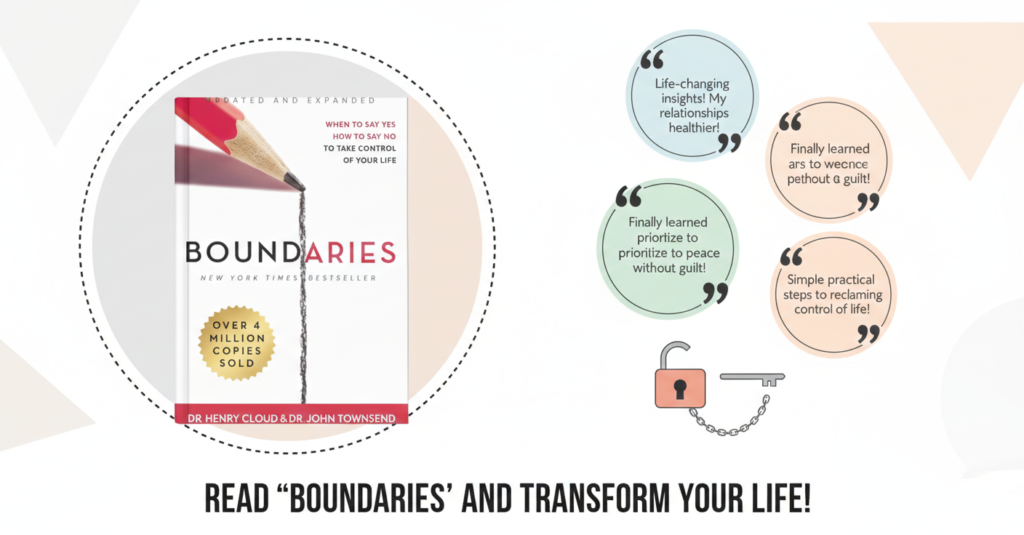
The concept of “boundaries” has exploded in popular psychology and social media therapy circles. But long before TikTok therapists were breaking down attachment styles in 60-second clips, Dr. Henry Cloud and Dr. John Townsend wrote the definitive manual on the subject. Boundaries: When to Say Yes, How to Say No to Take Control of Your Life is often cited as the bible of interpersonal limits.
But does this bestseller, originally published in 1992 and updated in 2017, still hold up? Is it a practical guide for modern burnout, or is it outdated advice wrapped in a digital format? In this comprehensive boundaries ebook review, we break down the core philosophy, the ten laws that govern healthy relationships, and whether this text provides the toolkit you need to finally stop people-pleasing.
Book Overview: A Manual for Personal Property Lines
Dr. Henry Cloud and Dr. John Townsend are clinical psychologists who recognized a pattern in their patients: many people suffering from depression, anxiety, and relationship struggles shared a common inability to say “no.”
The central metaphor of the Boundaries ebook is simple yet profound: a boundary is a personal property line. In the physical world, fences and signs tell us where our property begins and ends. We know we are responsible for mowing our own lawn, but we aren’t responsible for mowing the neighbor’s. Cloud and Townsend argue that we need these same distinct lines in our mental, emotional, and spiritual lives.
Without clear boundaries, we end up taking responsibility for things that aren’t ours—like other people’s feelings, reckless behaviors, or happiness. Conversely, we often neglect what is our responsibility—our own feelings, attitudes, and behaviors.
The 2017 Updated and Expanded Edition, available on platforms like Kindle and Glose, addresses how these principles apply to the digital age. It tackles the unique pressures of social media, “always-on” work cultures, and the blurring lines between public and private life. While the core text remains rooted in the authors’ Christian faith, the psychological framework is built on cognitive-behavioral principles that apply to anyone struggling with codependency.
Key Takeaways: The Ten Laws of Boundaries
The meat of the book lies in its “Ten Laws of Boundaries.” These aren’t arbitrary rules but rather principles of cause and effect that operate whether we acknowledge them or not. Understanding these laws is essential for anyone looking to stop the cycle of resentment.
1. The Law of Sowing and Reaping
This is the foundational principle: actions have consequences. If you smoke, you damage your lungs. If you spend more than you earn, you go into debt. In relationships, people-pleasers often interrupt this law. They step in to pay off a spendthrift friend’s debt or make excuses for a perpetually late colleague. By protecting others from the natural consequences of their actions, you render them powerless to change. The book argues that boundaries allow people to reap what they sow, which is the only way maturity happens.
2. The Law of Responsibility
This distinction is the book’s most critical takeaway: You are responsible to others, but you are not responsible for others. To be responsible to someone means to treat them with love, kindness, and respect. To be responsible for them means taking ownership of their well-being and happiness. If you feel responsible for a moody partner, you become a prisoner to their emotional state.
3. The Law of Power
We often believe we have the power to change people. We think, “If I just explain it better, they will stop being critical,” or “If I love him enough, he will stop drinking.” Cloud and Townsend posit that we do not have the power to change others; we only have the power to change ourselves. You can’t make your boss nicer, but you can change how you respond to their behavior or whether you choose to stay in that job.
4. The Law of Respect
If you want others to respect your boundaries, you must respect theirs. This is often a hard pill to swallow for those who feel victimized. If you get angry when someone else says “no” to you, or if you use guilt to manipulate others into compliance, you are violating their boundaries. Respecting the freedom of others is a prerequisite for having your own freedom respected.
5. The Law of Motivation
Why do you say “yes”? If your motivation is fear (of anger, of loneliness, of losing approval), then your “yes” is not an act of love; it is an act of compliance. The authors argue that a valid boundary must be set from a place of freedom. If you can’t say “no,” your “yes” means nothing.
6. The Law of Evaluation
Setting boundaries is painful because it often hurts others. If you stop enabling a friend, they will feel hurt. The Law of Evaluation requires you to understand the difference between “hurt” and “harm.” The dentist hurts you to fix your cavity, but they do not harm you. Similarly, your boundary might hurt a friend’s feelings, but it ultimately helps the relationship by introducing honesty.
7. The Law of Proactivity
Many people only set boundaries when they explode in anger. This is a reactive boundary. A proactive boundary is calm, planned, and preventative. It involves stating what you will and will not do before the situation escalates. It is the difference between screaming “Stop interrupting me!” and calmly stating, “I will not continue this conversation if you keep interrupting me.”
8. The Law of Envy
Envy is a signal. It tells you what you are lacking. If you envy a friend’s free time, it signals that you have poor boundaries around your own time. Instead of suppressing envy, the book suggests using it as a radar to identify where your own boundaries have collapsed.
9. The Law of Activity
Passive people wait for life to happen to them; active people take initiative. Boundaries require activity. You cannot wait for someone else to stop trespassing on your property; you must build the fence yourself.
10. The Law of Exposure
Your boundaries must be communicated. A secret boundary is no boundary at all. You cannot expect people to read your mind. If you are resentful that your partner doesn’t help with the dishes, but you’ve never explicitly asked for a specific division of labor, your boundary is invisible.
Personal Impact: Applying Boundaries in the Real World
The theory is sound, but the application is where the Boundaries ebook truly shines. The authors provide scripts and scenarios that feel uncomfortably familiar.
In the Workplace
The book addresses the “good worker” syndrome. This is the employee who takes on extra projects because they are capable, only to become bitter when they are overlooked for promotions or burn out. The text helped me realize that by saying “yes” to everything, I was actually performing poorly at my core responsibilities. A boundary here looks like saying, “I would love to help with that project, but my current workload is at capacity. Which of my existing priorities should I deprioritize to make space for this?”
With Family
Family dynamics are the final boss of boundary setting. The book discusses the concept of “triangulation,” where a family member complains to you about a third person rather than resolving the conflict directly. The Boundaries solution is to refuse to be the middleman. It forces you to say, “I love you, but I’m not comfortable talking about Mom when she isn’t here to defend herself. You need to speak to her.”
The Digital Leash
The updated edition’s focus on technology is vital. We often feel we “must” reply to texts instantly. The book reframes this: your phone is a tool for your convenience, not a tracking device for others to demand your attention. Turning off notifications or waiting 24 hours to respond is not rude; it is a necessary act of self-preservation.
Critical Review: Is it Right for Everyone?
While Boundaries is a bestseller for a reason, it is not without its flaws. A balanced review requires looking at who this book is for—and who might find it difficult to digest.
The Pros
- Actionable Scripts: The book doesn’t just tell you to “be firm”; it gives you the exact words to say. This is invaluable for people who freeze up during confrontation.
- Psychological Depth: It moves beyond surface-level advice and digs into the childhood origins of boundary issues. It helps readers understand why they are people-pleasers (often rooted in a fear of abandonment).
- Permission to Guilt-Free Living: The most liberating aspect is the debunking of guilt. The authors distinguish between “false guilt” (feeling bad for doing the right thing) and true guilt (remorse for doing wrong).
The Cons
- Heavy Religious Context: This is a Christian book. The arguments are heavily supported by Bible verses. While the psychological principles are sound, secular readers may find the frequent scripture references distracting or irrelevant. If you are allergic to religious language, this might be a barrier, though the core advice remains valid.
- Anecdotal Evidence: The book relies heavily on “pastor stories” and case studies from the authors’ practice rather than hard scientific data or peer-reviewed studies.
- Simplistic Resolutions: In the anecdotes, the person sets a boundary, and eventually, the relationship heals or the conflict resolves neatly. In reality, setting boundaries can lead to permanent estrangement or job loss. The book is optimistic, perhaps sometimes overly so, about the outcomes.
Practical Application: Implementing Boundaries Today
If you decide to download the Boundaries ebook, do not just read it passively. It requires work. Here is a step-by-step guide to applying its principles immediately:
Step 1: Identify the Resentment
Resentment is your radar. Anywhere you feel angry, used, or resentful is a place where a boundary has been violated. Stop suppressing the anger and use it to map out your property lines.
Step 2: Define the Consequence
A boundary without a consequence is just a nag. You cannot say, “Stop speaking to me like that.” You must say, “If you continue to yell, I will leave the room/hang up the phone.” The consequence must be something you have the power to do.
Step 3: Communicate Clearly
Use “I” statements. “I feel overwhelmed when you add tasks to my plate at 4 PM. In the future, I will not be checking email after 5 PM.”
Step 4: Prepare for the ‘Change Back’ Reaction
When you change the rules of a relationship, the other person will react. They might get angry, guilt-trip you, or withdraw. This is called the “change back” move—they are trying to force you back into the old dynamic where they were comfortable. Expect this. It is not a sign that your boundary is wrong; it is a sign that it is working.
Step 5: Get Support
The book emphasizes that you cannot set boundaries in a vacuum. You need a support system—a friend, a therapist, or a support group—who will validate your “no” when you feel like caving in.
Conclusion: A Necessary Read for the Burned Out
Is the Boundaries ebook worth your time and money? If you find yourself constantly exhausted by the demands of others, unable to pursue your own goals, or trapped in controlling relationships, the answer is a resounding yes.
While the religious overtones may not suit every reader, the psychological framework of ownership and responsibility is universal. It teaches you that saying “no” is not an act of selfishness, but a requirement for a healthy life. By defining who you are and who you are not, you gain the freedom to love others better—because you are doing it out of choice, not obligation.